Company / KADE Technologies

Built in Qatar. Designed for institutions worldwide.

KADE Technologies is developing intelligence infrastructure for capital markets. It’s designed to help portfolio and risk teams see what drove a result and why another analysis may differ, within the systems they already use.

Every decision begins
long before anyone is asked to make it.

Beneath the noise of every market,
there's evidence worth reading closely.

KADE keeps it in view
as the day moves on.

When one market closes,
another desk reads the same evidence.

The decision stays
with those who answer for it.

01 / Why we buildInstitutional decision-making

Markets move. Accountability remains.

A decision needs more
than an answer.

Know what informs the read.

See the evidence behind it.

Keep authority with the institution.

02 / How we work

Context. Evidence.
Control.

Start with the institution’s mandate and data permissions. Keep the evidence with the result so reviewers can check how it was reached.

01 /ContextWhat informs the read

Preserve institutional context.

The institution’s mandate sets the terms of the review. Its access rules determine which holdings, market data and other sources KADE can use.

Inside this layer

Sources · Mandate · PermissionsThe permitted sources, institutional mandate and access permissions establish what the read may use.
Explore the approach
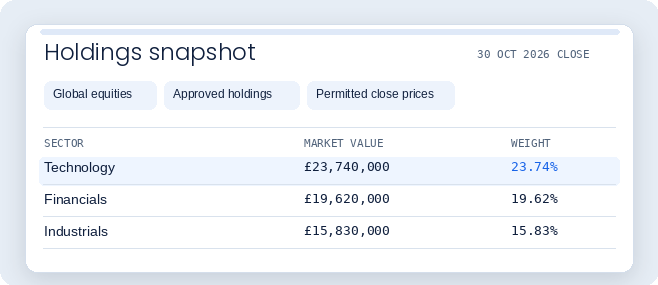
Illustrative read 0042. Global equities snapshot at 30 October 2026 close. Technology 23.74%, financials 19.62%, and industrials 15.83%. Permitted inputs include the approved holdings snapshot and permitted close prices.
Illustrative data · No live data · Read 0042View detail ↗
02 /EvidenceWhat stays with the result

Keep the working in view.

KADE is in development. See current product status.

Inside this layer

Factors · Configuration · VersionThe analytical record is designed to retain contributing factors, configuration and version for review.

Explore the lenses
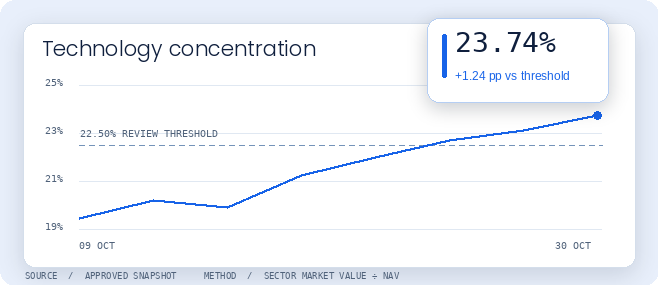
Illustrative read 0042. Technology weight rises from 19.42% on 9 October to 23.74% on 30 October, 1.24 percentage points above the illustrative 22.50% review threshold. Method: sector market value divided by portfolio net asset value.
Read 0042View detail ↗
03 /ControlWhere the decision stays

Keep the decision with the institution.

KADE is designed to bring findings and their supporting evidence into the institution’s review process. The institution decides who can see the findings and who can act on them.

Inside this layer

Workflow · Boundary · AuthorityThe institution defines the permitted workflow, deployment boundary and decision authority. KADE provides analytical context; it does not provide investment advice or execute transactions.

Explore deployment
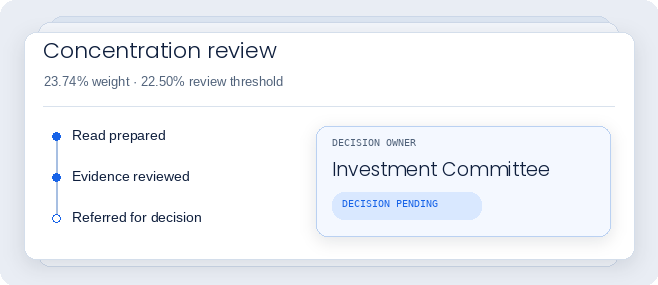
Illustrative read 0042. The Portfolio Lens prepared the read, Portfolio Risk reviewed the evidence, and the investment committee owns the pending decision.
Read 0042View detail ↗

03 / Where KADE fits

Your systems
keep their roles.

KADE is designed to sit alongside the tools institutions use for market data, portfolio management and research. It brings analysis and its supporting evidence together for review.

  1. Market data and analytics

    Data, portfolio analytics and connected workflows.

    Bloomberg
  2. Investment and risk platforms

    Portfolio management, risk and investment operations.

    Aladdin
  3. AI research platforms

    Search, cited research and information synthesis.

    AlphaSense

KADE / Intelligence infrastructure

A read you can inspect.

  1. Permitted context

    Sources · Holdings · Mandate

  2. Independent reads

    Proposed launch lenses · TELESCOPE

  3. Retained evidence

    Factors · Configuration · Version

04 / Leadership

The people
behind KADE.

KADE Technologies is based in Doha. Our board brings experience in capital markets and institutional governance. Our executive team leads engineering and product development, with input from business leaders across investment, governance and growth.

Meet the people behind KADE

Talk to the team.

Tell us what your team needs to review, which systems it uses and any rules on how the data can be handled.